
Montebello Previous Residents Sources
A past-residents search needs an era plan. Current parcel identity comes from the Assessor Portal. Recorded land documents reach back to 1850 but require grantor, grantee, and year searching at an office terminal or through a copy request. Printed directories and census schedules show people connected to a place at a particular date. Sanborn maps test building and street continuity. Permits can mark an alteration or transition. Probate, obituaries, and vital records can close a family trail under their own access rules.
| Source | Years covered | Where held | What it shows |
|---|---|---|---|
| Recorded real-estate documents | 1850–present county holdings | LA RR/CC Recorder | Grantor, grantee, transfer, liens, legal description, recording date |
| Assessor parcel and map | Current roll and map | LA County Assessor | AIN, situs, legal, value, building context, parcel link |
| Pacific Directory Company volumes | 1948, 1950, 1952 | Library and genealogy catalogs | Historical name and directory context; fields need inspection |
| White pages and regional directories | 1975–1977; 1987–1992 | LOC and Norwalk Californiana | Listed name, address, phone, and later address-oriented runs |
| Federal and California census | 1850–1950 public schedule layer | Federal and library collections | Household members, age, birthplace, place, and occupation where shown |
| Sanborn atlas | March 1925 verified | Library of Congress | Building footprint, use, materials, street alignment |
| City permits and probate | Dates vary; probate 1983–present name index | Montebello and LASC | Work history, heirs, petitions, notices, and public filings |
Begin with the era that matters. The recorder owns the land chain. The library owns the strongest verified directory shelf. City Hall owns municipal permits and requests. Court and vital records require a reasoned access path. No single source supplies a complete list of previous residents, so the sources must be joined with care.
Start with the Montebello AIN
Normalize the current street address through USPS, then open the Los Angeles County Assessor Portal. Capture the AIN, situs, legal description, map position, tax-rate area, and building context. Situs is the physical taxable location. A mailing address is correspondence destination. A legal description names the land through tract, lot, parcel, or similar language. Those strings can differ, so save all three.
The parcel map can reveal adjacent AINs and a development pattern. A City Hall sample for 1600 W. Beverly Boulevard displays AIN 5294014903, map and legal fields, values, building traits, and a transaction-event index. The Ownership tab supplies recording date and document reference but no party names or deed image. Carry that reference to the recorder rather than treating the assessor event as a deed.
The current parcel is the best bridge into the backward trail, even when the present address did not exist in the earliest record.
Walk the Los Angeles Deed Chain
Los Angeles County’s recorded-property holdings begin in 1850. The index is not a public online address search. It uses grantor name, grantee name, and recording year. To trace a Montebello parcel, start with the current vesting or a deed already in hand, then search backward through the prior party. Confirm every step with the same legal description, parcel lineage, or map evidence.
- Normalize the current address and save the assessor AIN and legal description.
- Find the latest deed or recorded reference through RR/CC, using the current grantee and approximate year.
- Write down the grantor, recording date, document number, and legal description.
- Search that grantor as a grantee in the prior period, then repeat backward.
- When the chain reaches an older tract, rancho, lot, or county description, compare the map and legal language instead of the modern street alone.
- Grantor
- The party conveying an interest in a recorded transaction.
- Grantee
- The party receiving an interest in that transaction.
- Chain of title
- The linked sequence of recorded transfers that explains how an interest moved.
- Legal description
- Land-identifying text that can survive a street-name or number change.
Norwalk headquarters reviews 1958–present records at 12400 Imperial Highway, Room 2207. Records from 1851–1957 are in Room LL001. The office publishes in-person inspection, written index search, and online, mail, or fax copy channels. It does not accept telephone index searches. Complete documents must be purchased when a copy is ordered.
The recorder viewing page supplies terminal locations, hours, and index mechanics.
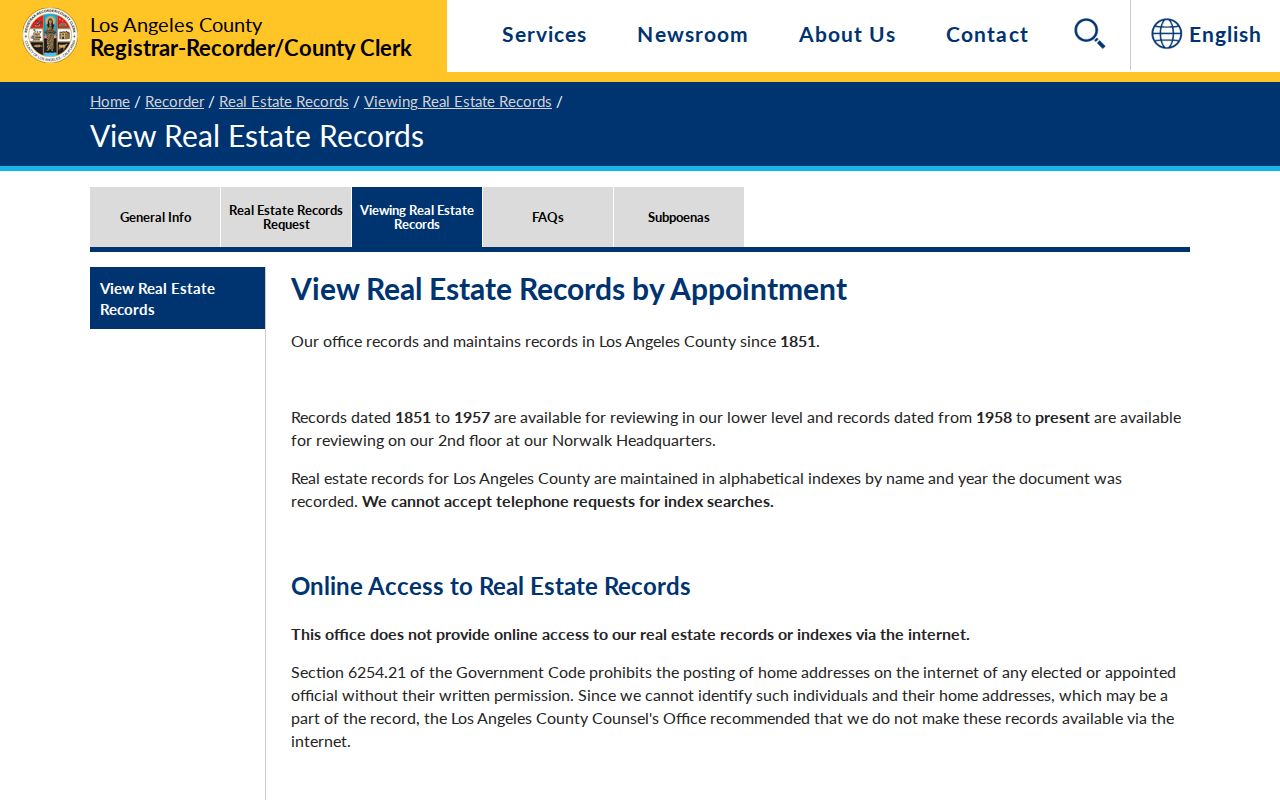
The terminal image belongs at the point where an online parcel clue becomes an in-person party search.
Recorder Depth and Copy Fees
The recorder’s time depth is a strength, but the access boundary matters. A written index search costs $0.50 per name per year with a $1 minimum. Plain copies cost $5 for the first page and $3 for each additional page. Certified copies cost $6 for the first page and $3 for each additional page. The department’s real-estate request guidance starts at 1850, and the complete document rather than selected pages is purchased.
Use the fee page to plan a narrow request. Identify the document type, parties, approximate year, parcel or legal description, and whether a plain or certified copy is needed. An office terminal can expose the index path before a copy is ordered. The copy channel is online, mail, or fax; telephone staff should not be expected to perform the search.
RR/CC recorder fees are the current source for the published amounts.
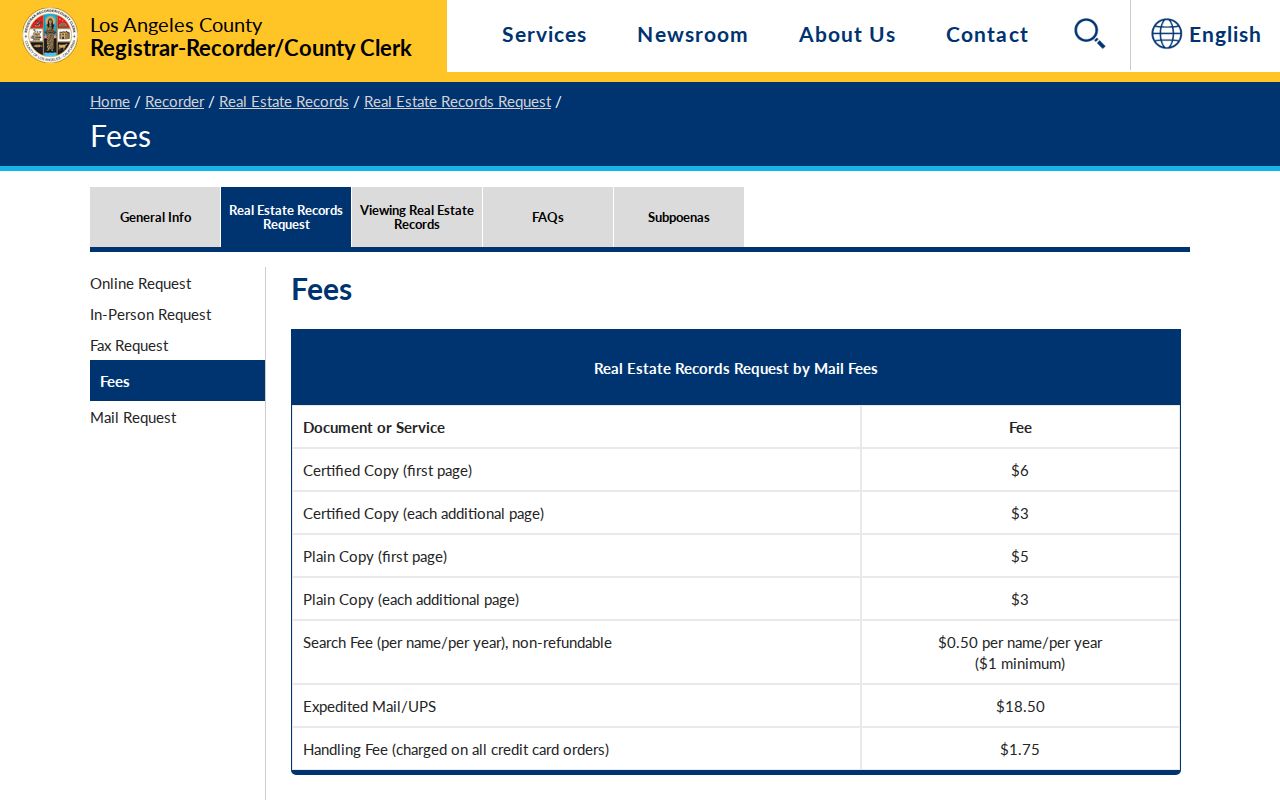
The fee capture helps separate an index search from the cost of the underlying document.
The recorded deed copy request explains the request route and the county’s 1850-present holdings.
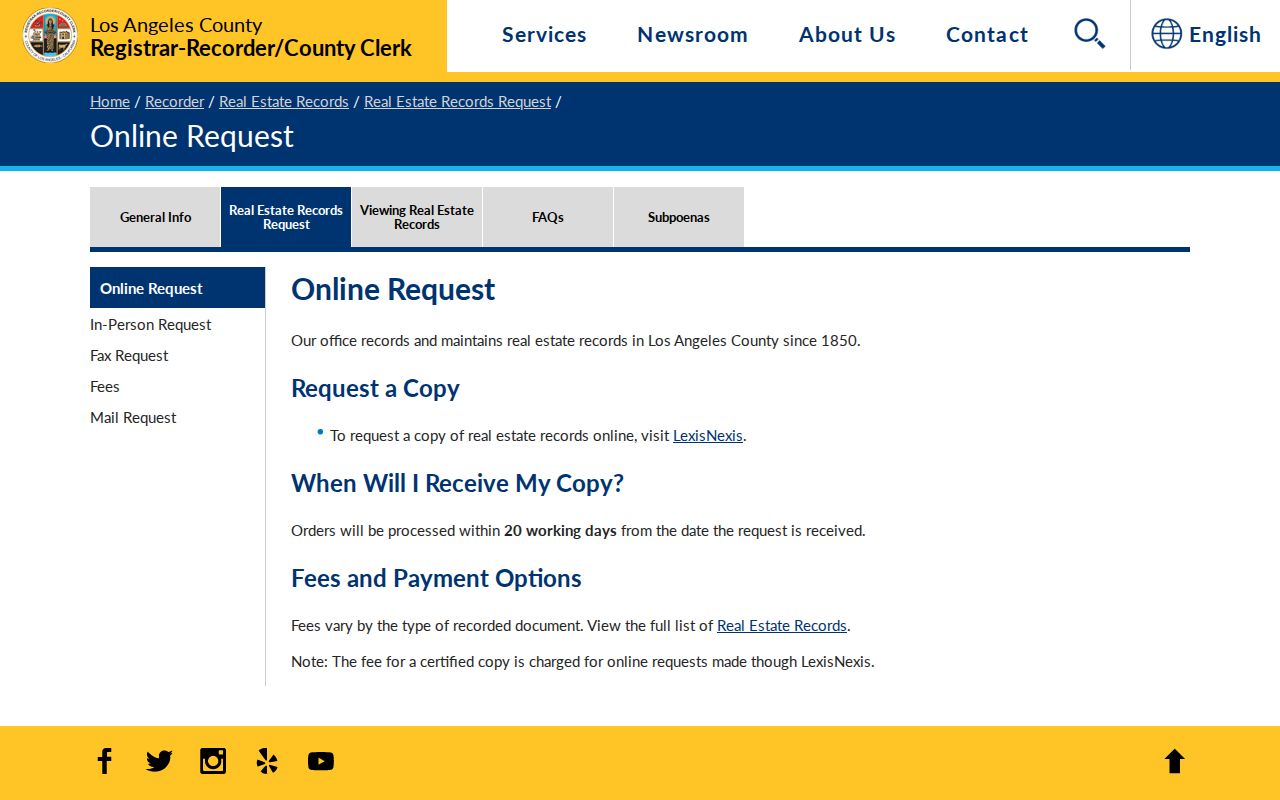
Use the request page when the deed image, not only its index line, is needed to establish a transfer.
Owner and Occupant Are Different
A deed names a transaction party. An assessor record describes a parcel. A directory may list a telephone subscriber or address entry. A census enumerates a household at a point in time. A permit names an applicant, owner, or contractor tied to work. These are different evidence types. The previous residents of a Montebello address may not be the same people who owned the land, and a recorded owner may not represent every person present.
Keep a research log with columns for source, date, name as printed, address as printed, role, parcel, and confidence. Mark a person as listed, enumerated, recorded party, applicant, heir, or licensee. Those labels preserve what the source actually says about previous residents. If a directory and deed differ, the difference is a clue to investigate, not an error to smooth away.
House-history rule. A land transfer can prove a recorded party, while a directory or census can place a household at an address. Use both before writing a conclusion.
Montebello Previous Residents in Directories
The household layer for previous residents comes from the library and archive side. Verified local material includes Pacific Directory Company titles for 1948, 1950, and 1952; free Library of Congress white pages for January 1975, 1976, and 1977; and Alhambra–Montebello Pacific Bell volumes from 1987 through 1992. The Norwalk Californiana Collection also holds California census schedules from 1850 through 1910. The full collection details belong to the Montebello city directories page.
Pair the closest sources by year. A directory line can supply name, address, locality, and phone. A census can supply household members, relationships, age, birthplace, and place. A later directory can show a move or a changed spelling. A deed can say who held the land. The sources should be compared, not merged into one record.
- Copy the directory title, year, page, exact name, street form, and locality abbreviation.
- Check the address-order or criss-cross section when that edition includes one.
- Pair the year with the nearest public census schedule and compare household details.
- Search newspapers, obituaries, probate, and vital indexes when a name vanishes.
- Use deeds and Sanborn sheets to test whether the land and building stayed continuous.
The 1948, 1950, and 1952 books have a documented research gap: no open resident entry was inspected, so spouse, occupation, widow, and owner-or-occupant fields remain unverified. The gap should stay visible in any house history.
Montebello’s 1925 Building Snapshot
The March 1925 Montebello/Pico Sanborn atlas contains 19 sheets and is a valuable early-incorporation checkpoint. Sanborn maps show building footprints, materials, uses, street alignment, and lot context. They do not name every occupant. Compare a sheet with an address listing, then tie the map to a legal description or tract before claiming that an older building is the same parcel.
The map is especially helpful when a modern street string fails. A house number may have shifted, a street may have carried another name, or a rural or tract description may have been used. The Sanborn sheet supplies a physical clue that can be matched with a deed, directory, newspaper, or census location.
The Library of Congress Sanborn record identifies the verified 1925 Montebello/Pico edition.
Permits Mark Address Change
Montebello permits can help date additions, alterations, demolition, and other changes at an address. The B-001 form asks for permit and site details, scope, area, occupancy group, construction type, stories, rooms, units, valuation, owner and contractor information, and approval boxes. Public production may redact personal phone and email fields.
OpenGov handles the current Public Works permit workflow with account creation, uploads, payment, status, and comments. The published research did not locate a searchable historical cutover date. Use the city counter or a focused CPRA request for an existing permit, inspection, plan, or correspondence file when the online workflow does not reach the relevant period.
Permit evidence can show when a structure changed. It cannot prove who lived there before or after the work.
Probate and Obituaries Close Trails
When a former occupant disappears from a directory, probate and obituary sources can explain a death, an heir connection, or a move without guessing. Los Angeles Superior Court’s probate name index reaches 1983 to the present. A public petition, notice, estate filing, or recorded affidavit may name relatives or an address, but sealed and confidential material remains unavailable. An obituary is family-supplied and should be corroborated with a death index, certificate, cemetery record, or probate file.
California vital-record forms distinguish authorized and informational copies. Birth, death, and marriage applications ask for the subject, event facts, requester relationship, copy type, signature, and payment. The state’s 2026 fee benchmarks are $31 birth, $26 death, and $19 marriage. A mailed authorized request may require a notarized sworn statement. Use the official form, not an old secondary-source address.
CDPH’s vital-record forms are the documented access channel.
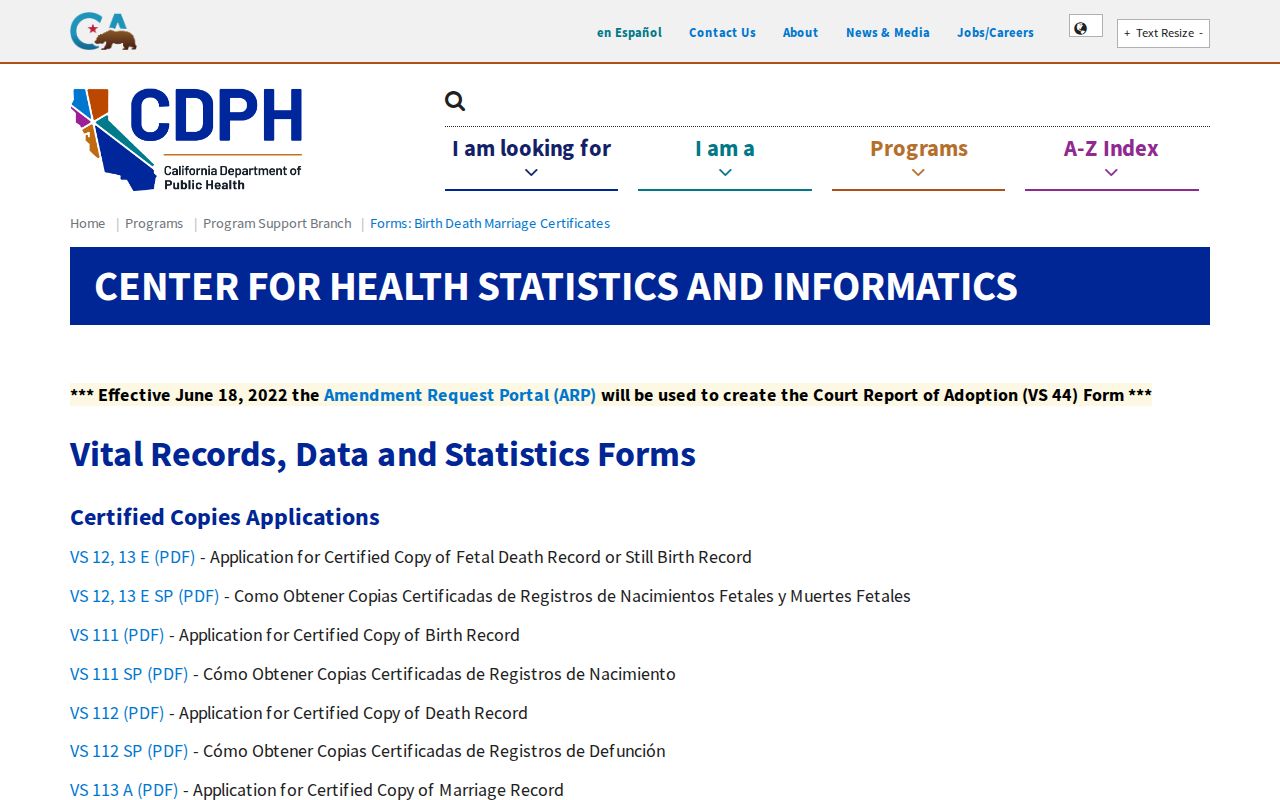
The vital-form image marks the point where a family-history lead becomes an eligibility-controlled request.
Bridge Vanished Addresses
Montebello incorporated in 1920, but county land records begin in 1850. Older references may use mission, rancho, tract, lot, county, or land-grant language. A modern city and ZIP label should not be copied backward. Use a chain of identifiers: present USPS address, assessor AIN, legal description, older deed, Sanborn sheet, directory entry, census place, and family or probate clue.
Search variants deliberately. Try street-direction and suffix changes, old numbers, tract names, compound surnames, each surname separately, initials, married or maiden forms, and spelling with or without diacritics. A vanished address can be a renumbering, subdivision, annexation, move, unlisted telephone, OCR error, or land description shift.
For a current whole-street comparison, use the Montebello by-street address workflow. The previous residents method remains focused on one parcel moving backward through time, with previous residents treated as dated evidence rather than a live roster.
Safe House History Research
Protected addresses create purposeful gaps. California Safe at Home supplies a substitute address for qualifying participants. Voter, DMV, vital, juvenile, sealed, and confidential records also have separate limits. A missing person from a public index is not proof of absence, death, or a false record. It is a prompt to check the custodian’s access rule.
Lawful personal use. Use previous-resident research for genealogy, property history, estate questions, and reconnection. Never use records to stalk, harass, intimidate, or harm anyone.
Preserve source links, page images, request receipts, and the wording of every conclusion. Confirm land records with RR/CC, court records with LASC, vital events with RR/CC or CDPH-VR, and historical entries with the library or archive that holds the edition.